
HDB Setup, Cat Breed Prices, Daily Care, Outings & Boarding in Singapore
Your first cat does not need a perfect home. It needs a prepared one. Before the shopping basket comes a few bigger questions: Is the flat secure? Where will the litter tray go? What should the first month cost? And whom do you call if your cat seems unwell?
This Singapore guide brings those decisions together: HDB rules, choosing a cat, practical setup costs, food and litter budgets, daily care, safe outings and help when you travel. Comparing pedigree cats? Start with the breed introductions and local price examples, then use the before-buying checklist and first-year and ongoing cost planner. Taking your cat out? Use the carrier, transport, heat and insect-care checklist. Travelling without your cat? Read how to choose boarding and compare the three cat-boarding options.
There are small savings along the way, too. A S$16 basket plus S$2.50 delivery costs S$18.50. Adding an unnecessary S$9 item for free shipping costs S$25: S$6.50 more. A thoughtful first basket leaves room for the care your cat will actually need.
You will find an S$81 example equipment basket, a way to reduce it to S$71 if you already own suitable bowls, and a worked example showing why S$40 spent does not mean S$40 used. These are parts of a budget; home safety, a carrier, food, litter and veterinary care need their own lines.
Save the boarding contacts, nine-entry adoption directory, six veterinary contacts and five cat cafés and experiences for later. Already home with your cat? Jump to 15 quick answers to common problems.
Dental-care guidance, fee examples and oral-care product information checked: 13 October 2026. Outings, heat and insect-care guidance updated: 8 October 2026. Cat breed prices, buying checks and boarding section updated: 5 October 2026. Earlier care guidance and directories checked: 25 September 2026. Kopipets product-price examples checked: 24 September 2026. All amounts are Singapore dollars. Product prices refer to the options linked below, before unverified discounts. Consumption examples are calculations, not feeding recommendations or promises about how long supplies will last.
Before checkout: give your first dollars a job
- 2 cats: the usual HDB limit. Make sure the flat works for one before considering a second.
- S$31.50: a sterilised cat's lifetime licence after the published 10% online-payment rebate, within the first-three-pets fee category.
- S$81: the example reusable-equipment basket below. It is only one part of the setup budget.
- S$4 per 300g: the listed Kopipets dry-food price used for our food calculations.
- S$20: Kopipets' published free-delivery threshold. Reaching it only saves money if the extra items are useful.
Buy in this order: secure the home and arrange safe transport; prepare toilets, food, water and a scratching spot; set aside money for care; then consider convenience upgrades.
Keep three budget lines: setup purchases, regular spending and savings for future care. Moving money into savings is different from spending it.
Jump to: HDB rules · Cat breeds & prices · Home layout · Shopping list · Food maths · Litter budget · Vet costs · Dental care & mouthwash · First-month plan · Taking your cat out · Cat boarding · Adoption contacts · Vet contacts · Cat cafés · 15 quick answers
1. Before bringing a cat home: paperwork, records and adoption
Before paying for a procedure or buying supplies, ask what comes with your cat. A written record can help you avoid repeat purchases and plan the next appointment.
SPCA Singapore lists S$80 for a local adult cat aged six months to under 7.5 years, and S$100 for a local kitten under six months. Adoption includes vaccination, sterilisation, deworming and microchipping; the licence is separate. Ask for the cat's records and the next care dates. SPCA adoption fees and requirements.
Worked example: S$80 adult-cat adoption + S$31.50 sterilised lifetime licence = S$111.50, before equipment, home safety work, transport and ongoing care. Other rescue groups have their own fees and inclusions.
Choose a cat whose temperament and needs fit your household. Ask about handling, previous home life and any ongoing care. Our adoption directory explains where to enquire and which organisations arrange meetings through foster homes.
Finish the HDB and licence checks before collection
HDB flats normally allow up to two cats, alongside one dog of an approved small breed. The exception for cats already owned before 1 September 2024 depended on licensing them by 31 August 2026; it does not let a new household exceed the usual limit. See AVS ownership limits and the transition-period notice.
Your cat needs a microchip before licensing. First-time applicants must complete the free online pet ownership course. Install suitable barriers to prevent falls and escape, and keep your cat physically controlled in public, using a carrier or harness. Read the AVS requirements.
The free-licensing transition ended on 31 August 2026. For the first three cats and dogs combined, a sterilised pet's published licence fees are S$15 for one year, S$25 for two years or S$35 for a lifetime. A 10% online-payment rebate makes the lifetime option S$31.50. This fee category does not change the HDB ownership limit; microchipping and sterilisation are separate procedures. Check the current AVS fee schedule.
Eligible lower-income households may receive sterilisation and microchipping support through the Pet Cat Sterilisation Support programme. Check the eligibility criteria before budgeting for those procedures.
Absolute rule or organisation policy? Licensing and safe keeping are AVS requirements. Sterilisation is strongly encouraged by AVS, but is not a general legal requirement under its cat-licensing scheme. CWS includes it in its own responsible-ownership framework, and adoption agreements may require it. Discuss suitable timing with your vet. CWS explains its standards.
2. Buying a cat in Singapore: breeds, prices and the checks that matter
A breed can help you understand likely coat care, size and activity needs. It cannot tell you exactly how an individual cat will behave. Meet the cat, ask about its daily routine and choose a companion that fits the time and space you can offer.

Singapore pedigree cat prices: a starting point for your budget
Public price information checked on 5 October 2026. This table combines advertised starting prices and seller-published price guides from Singapore catteries. It is not a survey of the whole market or a set of guaranteed quotes. “From” is a seller's starting price, with no published upper limit. Compare what is included before adding equipment, licensing, food, litter, grooming and veterinary care; follow each source and request a current quotation.
| Breed and a quick introduction | Published price example |
|---|---|
|
British Shorthair Round face and plush short coat; often calm and quiet. |
Designer Cats: from S$5,500. Fluffydolls price guide: S$6,000–8,000. These examples are not a market ceiling. |
|
British Longhair A round-faced, easy-going cat with a dense long coat that needs brushing. |
Fluffydolls price guide: S$7,000–9,000. |
|
Ragdoll Large, blue-eyed and semi-longhaired; typically gentle and sociable. |
Genesis Ragdoll: S$4,000–7,000, excluding the sterilisation deposit. Designer Cats: from S$6,000. |
|
Maine Coon A large, longhaired cat, often friendly and playful. Plan for its adult size. |
Designer Cats: from S$6,000. |
|
Bengal Spotted or marbled coat; curious and athletic, with substantial play needs. |
Designer Cats: from S$5,800. |
|
Persian Long flowing coat and short nose; often quiet. Regular coat care is a commitment. |
CuddleCats: from S$4,000, excluding sterilisation. Designer Cats: from S$6,000. |
|
Exotic Shorthair A Persian-like face and body with a shorter plush coat; often quiet and affectionate. |
CuddleCats: from S$4,000, excluding sterilisation. |
|
Russian Blue Short silver-blue coat and green eyes; often quiet but playful. |
Designer Cats: from S$6,000. |
|
Siberian Medium-to-large build with a thick triple coat; allow time for grooming. |
Designer Cats: from S$7,500. |
|
Sphynx Nearly hairless, active and affectionate. Skin care and temperature comfort still matter. |
Designer Cats: from S$5,900. |
|
Munchkin Short-legged, often playful and curious; assess movement and lifelong needs carefully. |
Designer Cats: from S$6,000. |
|
Scottish Fold / Scottish Straight Folded-ear and straight-ear varieties are sold under this listing. Confirm the exact cat and its health history. |
Designer Cats combined listing: from S$5,800. This does not establish the same quote for every Fold and Straight kitten. |
|
Devon Rex Large ears and a soft wavy coat; typically active and interested in people. |
Designer Cats: from S$6,500. |
Breed descriptions draw on the Cat Fanciers' Association breed profiles and TICA's British Longhair and Munchkin profiles. Temperament varies between individuals. Siamese and less frequently available breeds need a current local quotation; we did not verify a reliable public Singapore price for them.
Read the health history before the price tag
For longhaired cats, make grooming part of the weekly plan. For large cats, measure the carrier and tray against adult size. For active cats, leave time and space for daily play. A pedigree certificate describes ancestry; ask separately about health records and the parents' relevant screening.
Scottish Fold: the genetic variant that folds the ears also affects cartilage and bone and is linked to joint disease. A kitten appearing comfortable today does not settle its future care needs; severity varies. Discuss this with an independent vet before buying. UC Davis Veterinary Genetics Laboratory explains the variant.
Short legs or a very flat face: ask a vet about movement, comfort and potential lifelong care. The GCCF sets out welfare concerns about dwarf breeds; the RSPCA explains flat-faced cats' care risks. Do not buy on appearance alone.
Before paying a deposit: six practical checks
- Seller: match the business and licence details to the AVS public registry of licensed pet shops.
- Age and care records: under AVS pet-shop conditions, kittens kept for sale must be at least 12 weeks old, have received two vaccinations and have rested for at least one week after the second vaccination. Check the dated vaccination and deworming records with the seller.
- Identity: kittens must be microchipped by 12 weeks. Ask the seller to scan the chip and match it to the vaccination card, which must accompany the cat.
- Purchase screening and ownership: for a pet-shop purchase, complete the required Pet Purchase Declaration with the retailer and accept the ownership transfer in the AVS system before the shop releases the cat. Read the current AVS sale conditions.
- Written quote: ask what the price includes: vaccinations, microchip, sterilisation or its deposit, registration papers, transport and follow-up care. Before paying a deposit, ask when it is refundable, whether there is a deadline for an independent veterinary examination, and what happens if that examination finds a health problem. Get health, refund or replacement terms in writing and keep the agreement and payment receipt. AVS best practices recommend a clear understanding about illness or death; specific refund terms need to be agreed with the seller.
- Household fit: meet the cat and ask about handling, food, litter, grooming and time alone. Recheck your HDB limit and complete your home-safety work before collection.
First-year and ongoing costs: what the breed price leaves out
The price of the kitten is only the first entry. Before paying a deposit, put the written seller quote beside your setup list and regular-care budget. A lower purchase price does not establish a lower lifetime cost; the individual cat's diet, coat, size and health needs still matter.
| Budget line | What to include |
|---|---|
|
Acquisition and setup Before collection |
The agreed purchase or adoption fee; procedures excluded from the seller's package; licensing; safe transport and home protection; suitable equipment and familiar supplies. The S$81 equipment basket is one subtotal, with several essentials still to quote. Record any refundable deposit separately from the final cost. |
| First-year spending | Acquisition and setup, plus regular supplies, veterinary care due during the year, grooming if needed, travel care and other purchases. Use the seller's records to avoid budgeting twice for procedures already included. |
| Later-year spending | Food, litter and cleaning supplies; veterinary care and any continuing treatment; grooming where needed; boarding or in-home care when you travel; licence renewal if applicable; and replacement equipment. Recheck the plan as your cat grows or its needs change. |
| Accessible care reserve | Money kept ready for unplanned care. A transfer into savings is separate from spending. When that reserve pays a vet bill, count the bill once; do not add both the savings transfer and the bill to your care-cost total. |
First-year spending = acquisition and setup + regular monthly spending × 12 + planned care + travel-related care + other purchases. Keep each item in one category. Obtain the missing carrier, home-safety and care quotations before treating the result as a complete budget.
A limited annual example: the 50g/day dry-food calculation and three-bag litter scenario give S$20 + S$12 = S$32 per 30-day budget period. Repeating that period 12 times gives S$384 for those two items across 360 days; it is not a full calendar-year total or an all-in annual cat-care budget. It excludes other food, treats, cleaning, delivery, grooming, veterinary care, boarding and equipment. Replace the assumed quantities with your cat's measured use.
Build the ongoing plan from the cat you are choosing: agree who will maintain a long coat and obtain a grooming quote if you need help; choose the carrier and tray for adult size; and ask an independent vet what any known health finding means for follow-up care. Then use the veterinary fee examples and travel-care costs to fill in the remaining lines. Review actual spending yearly instead of multiplying a small food-and-litter subtotal into a supposed lifetime price.
Buying is only one route. If you are open to an adult or a local domestic cat, our adoption directory helps you compare temperament and known care needs without making breed the starting requirement.
3. A tray that fits your cat must fit your flat, too
Walk through the flat with a tape measure. Check windows, the service yard, balcony if you have one, and the main gate. Get a quote for the actual openings you need secured. A standard “meshing budget” is unreliable because homes and installation requirements differ.
SPCA requires suitable window and gate meshing, including toilet and service-yard windows. Its adoption guidance excludes flimsy or easily detached solutions such as magnetic mesh and tape attachments. Check the rescue's requirements before paying an installer. See SPCA's home-safety guidance.
- A quiet starting area: a room with a hiding box and resting space, away from renovation noise and frequent visitors.
- A toilet area: accessible around the clock, away from food, water and noisy appliances. A service yard only works if it is safe, quiet and accessible.
- Separate food and water spots: use stable, washable bowls and leave enough room to clean around them.
- A scratching spot: place a stable scratcher where your cat naturally rests or passes through, rather than hiding it behind furniture.
Use the AVS cat-care guide as your starting checklist. For a small flat, measure usable space after doors open and people walk past, not just the empty floor area.

Four jobs for a small HDB starting room
REST: a quiet hiding place and washable bedding.
EAT & DRINK: clean bowls, separated from the toilet.
TOILET: an accessible tray with familiar litter.
MOVE & SCRATCH: a stable scratching surface and safe play space.
This is a planning checklist, not a scale floor plan. Leave clear routes between resources and secure every escape opening.
The AVS owner poster advises mesh gaps under 5cm; kittens may need smaller openings. Check attachment strength and all edge gaps as well as mesh size. View AVS’s illustrated “8 Ways to Be a Good Cat Owner” poster.
Cat-proof the ordinary things, too
Secure reachable cables, small objects, medicines and cleaning products. Check plants before keeping them in an accessible room. Ask everyone at home to check the cat’s location before opening the main door or operating appliances.
Make three checks before ordering a tray
- The available footprint: measure the floor space with nearby doors fully open. Mark the proposed tray outline with removable tape.
- The usable interior: compare internal measurements as well as the overall size. High sides and surrounds take up space; check that your cat can enter and turn comfortably.
- The cleaning space: leave room to scoop, lift the tray and wipe around it. Test the movement before the tray is filled.
Do the same for a scratcher or carrier. A product photo cannot show whether it will block your own doorway.
Give each meshing installer the same checklist
List living-room, bedroom and toilet windows; service-yard openings; the balcony if present; and the main gate. For each, record the opening size, take a photo and note how it needs to open for everyday use. Ask each installer to specify materials, attachment method, installation and follow-up work. Comparing the same scope makes missing items easier to spot.
4. What does an S$81 equipment basket actually include?
Plan space for one litter tray per cat, plus one extra, ideally in separate accessible locations. This is a care recommendation, not an HDB rule. AVS recommends an extra set of essential resources for multi-cat homes, with resources spread out rather than crowded into one corner.
Here is a concrete Kopipets equipment example. Check each item's dimensions against your cat and flat before ordering; a lower-priced, appropriately sized tray can also work.
| Item | Quantity × price | Subtotal |
|---|---|---|
| Open-top stainless-steel litter tray, Khaki | 2 × S$23 | S$46 |
| Scoop and dustpan, 27 × 8cm | 1 × S$9 | S$9 |
| Stainless-steel bowl, Blue | 2 × S$5 | S$10 |
| Sisal scratcher bed, Cat Ear Style | 1 × S$16 | S$16 |
| Equipment subtotal | S$81 |
Still to budget: a secure, correctly sized carrier; window and gate protection; initial litter fill; familiar food; cleaning supplies; adoption and licensing; any veterinary work due. The S$81 subtotal excludes all of these. The scratcher above is listed as 61cm wide, so check its footprint.
Using the adoption example, S$111.50 + S$81 = S$192.50 in known items. Add your remaining quotes before deciding whether you can afford the complete setup.
Already own two suitable bowls? This example falls to S$71
Two stable, washable bowls you already own remove S$10 from the example: S$81 − S$10 = S$71. Check their condition and suitability first. You can make the same item-by-item check for other equipment you own; the saving depends on what can actually be reused.
Put these upgrades on a 30-day wishlist
Start with a clean cardboard hiding box and a washable blanket you already own. An automatic litter box, designer bed, camera, large cat tree and multiple toys can wait until you know your cat's preferences. Keep essential safety work and suitable veterinary care ahead of convenience upgrades.
Beside each wishlist item, write the problem it would solve. For a bed, first notice where your cat chooses to sleep. For a larger scratcher, check the surface and position your cat uses. For an automatic litter box, check the space, access and ongoing cleaning requirements. Make the purchase when you understand the need.
5. A S$4 pack is affordable. How many will you use?
The linked Kopipets Chicken & Fish dry food, 300g option is listed at S$4. That works out to S$13.33 per kilogram.
Monthly dry-food cost = grams used each day × 30 ÷ 300 × S$4.
| Assumed use | 30-day quantity | 300g bags / cost |
|---|---|---|
| 40g/day | 1.2kg | 4 / S$16 |
| 50g/day | 1.5kg | 5 / S$20 |
| 60g/day | 1.8kg | 6 / S$24 |
At the middle example, one 300g pack lasts six days. That is arithmetic, not a shelf-life claim. These figures cover only the dry-food portion; add wet food, treats, waste and delivery where applicable.
Choose a complete food appropriate to your cat's life stage. The right ration depends on the food's energy content and your cat's weight, activity and health; follow the label and veterinary guidance. Treats and complementary foods do not replace a complete diet. Keep fresh drinking water available and introduce food changes gradually. AVS explains age-appropriate nutrition.
Ask the shelter what the cat currently eats. Start with familiar food, then trial a small quantity of any new food before buying a carton. A bulk discount is only useful when the food suits your cat and can be used within its storage instructions.
Ask these questions before collection day
- What exact food, flavour and texture does the cat currently accept?
- How much of each food is being offered, and at what times?
- Which litter and tray style does the cat currently use?
- Are there veterinary diet instructions or care appointments to continue?
Write the answers down or photograph the packaging with permission. Bring the diet information and care records to your vet when reviewing the feeding plan.
Change food slowly; do not change everything on arrival day
Keep familiar food for the first few days. If a change is suitable, introduce it gradually over one to two weeks, adjusting to your cat’s response. For a kitten, confirm the new food is suitable for growth. Vet Central’s kitten guide explains the settling-in approach. A small trial pack is useful before a larger purchase; it should fit the cat’s feeding plan.
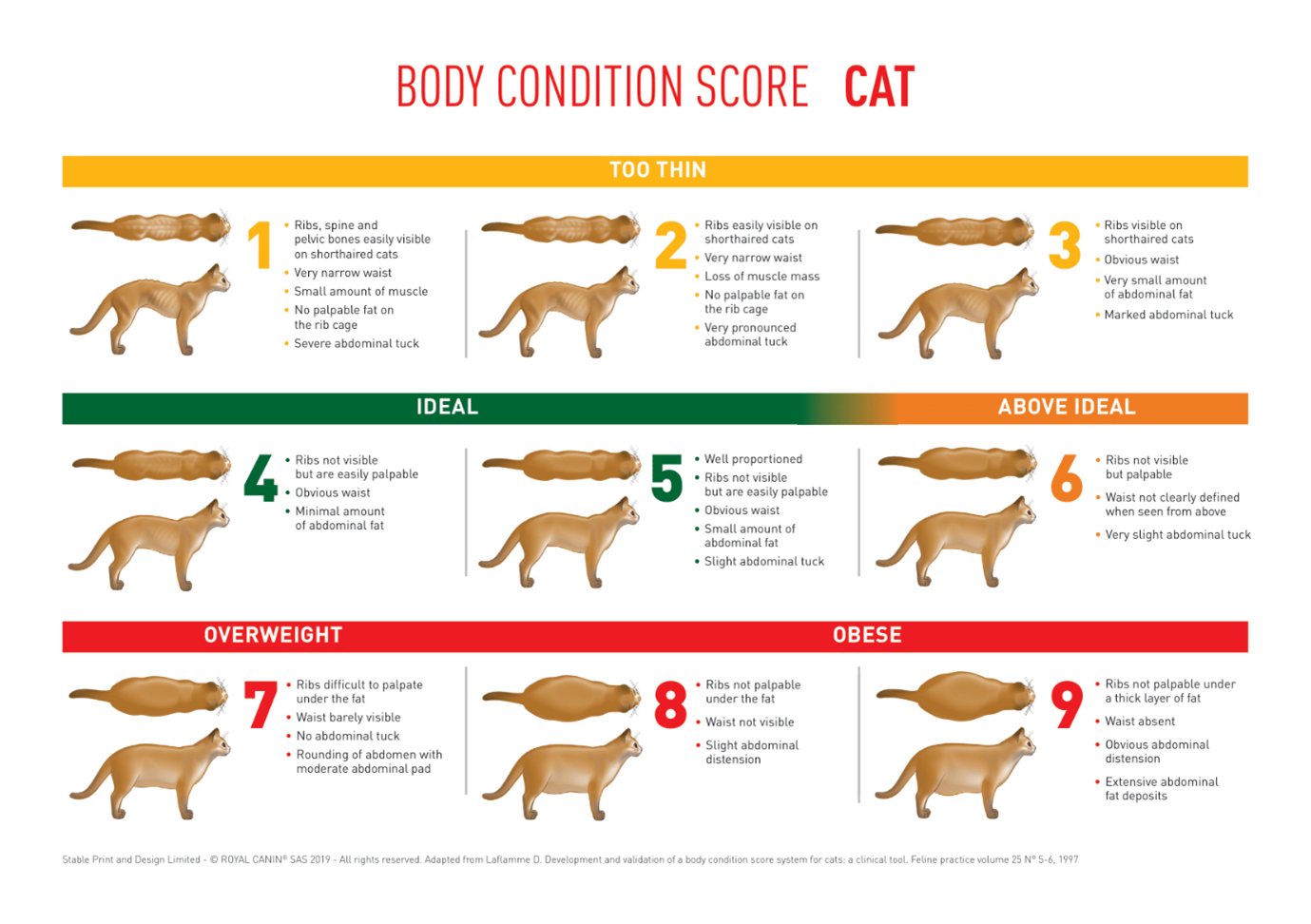
Is your cat well fed, or gradually gaining too much weight?
Track body condition alongside weight. Ask your vet to demonstrate how to gently feel the ribs, look for a waist from above and assess the abdomen from the side. A fluffy coat can hide changes; appearance alone is not enough. Use an agreed target for your cat’s age and health, especially while a kitten is growing.
Open the illustrated cat body-condition chart linked by AVS for a visual reference. Record weight and food amounts consistently, then review the trend with your vet. Do not sharply restrict food to match a picture.
A useful household habit: write down the day’s food allowance and record treats too, so two family members do not unknowingly give two dinners. The gram figures in our cost table are examples, not a target for your cat.
Count waste as part of the food bill
Suppose 30g of a S$4, 300g pack is discarded. Only 270g is used, so its effective cost becomes S$4 ÷ 0.27kg = S$14.81/kg used, rather than S$13.33/kg purchased. This is a waste example, not a measured Kopipets wastage rate. Testing acceptance and storing food properly can be worth more than buying extra packs for a discount.
What our laboratory report actually tells you
CTI report A2260816332101001E, dated 23 September 2026, records nine tested parameters for a submitted Kopipets Chicken & Fish dry-food sample. Selected reported results are:
| Tested parameter | Reported result |
|---|---|
| Crude protein | 38.56% |
| Crude fat | 16.0% |
| Moisture | 5.5% |
| Calcium / phosphorus | 1.29% / 1.11% |
| Taurine | 0.41% |
The report describes that sample and those tests. It gives no pass/fail limits and does not by itself establish complete nutritional adequacy or certify every batch. It also does not report pathogen, heavy-metal or mycotoxin testing. Use the product label and suitability information alongside the test results when choosing food.
6. Will two bags of litter last a month? Measure yours
Kopipets Original tofu litter, one 2.1kg bag, is listed at S$4, or approximately S$1.90/kg. Compare the same unit: kilograms and litres cannot be converted without knowing the material's density.
| Bags | Weight | Cost |
|---|---|---|
| 2 | 4.2kg | S$8 |
| 3 | 6.3kg | S$12 |
| 4 | 8.4kg | S$16 |
These are budget scenarios, not measured usage claims. Tray size, litter depth, scooping, full changes and your cat's habits affect consumption. Filling two empty trays can also make the first month's purchases higher than later refill costs.
Write the opening date on each bag. Record how much you use for the first fill, top-ups and full changes. After four weeks, calculate opening unused stock + purchases − closing unused stock. This is a better starting point for repeat orders than another owner's estimate.
For example, 50g of dry food daily plus three litter bags a month gives S$20 + S$12 = S$32. That is a two-item consumables subtotal, not the total cost of keeping a cat. Read our daily-cost calculation guide for a fuller budgeting framework.
A cleaner tray is usually a better first step than another fragrance
Scoop at least daily, keep the area accessible and clean the tray regularly. Follow the litter’s replacement instructions and your cat’s needs. Avoid making several tray and litter changes at once. Sudden toileting changes deserve a vet discussion, not just a new accessory. The AVS poster makes regular litter hygiene one of its eight care basics.
If familiar tofu litter suits your cat, the 2.1kg Kopipets pack gives you a clear unit for tracking refills. An effective budget starts with actual use and a tray your cat willingly uses.
7. Leave room for the bill that does not arrive monthly
Routine care is predictable enough to plan for; the full cost of an illness or dental procedure needs an individual estimate. Save a regular clinic and an emergency hospital in your phone before collection day.
| Item | Listed fee |
|---|---|
| Standard consultation | S$56 |
| Cat FVRCP vaccination | S$58 |
| Emergency consultation | S$165 |
| Dental procedure, pet below 10kg | S$400–430 |
| Extraction, per tooth | S$50–150 |
These are one clinic’s prices. Vaccination includes the vaccine-related health check; other concerns may attract a consultation charge. The dental price includes general anaesthesia and intravenous fluids but excludes consultation; extraction excludes medication. Emergency consultation is only the consultation charge. Ask for an itemised estimate covering proposed blood tests, imaging, anaesthesia, monitoring, extractions and medicines; the listing does not establish that all are included. Check SingVet’s current price list.
Build a care calendar with your vet
For a new kitten, arrange an initial check within the first week, sooner if unwell. Bring vaccination, deworming and microchip records. Ask the vet to set vaccine and parasite-prevention dates based on age, previous treatment and exposure, and discuss sterilisation timing. Plan an annual veterinary review, with additional visits and preventive-care dates based on your cat’s needs. Avoid choosing medicines from an internet timetable. Vet Central’s new-kitten guidance.
Cat dental care in Singapore: tiny teeth, a surprisingly big bill
Your cat has a tiny toothbrush-sized mouth. The dental bill, unfortunately, does not come in a tiny size. Build a gentle home-care routine while your cat's mouth is comfortable, and keep money available for professional assessment and treatment.
How much does cat dental cleaning cost in Singapore?
The SingVet figures above are one example. Two other clinics publish these cat-specific prices:
| Clinic | Listed procedure | What to check in the quote |
|---|---|---|
| Atlas Veterinary Clinic & Surgery | Cat scaling and polishing: S$450, including GST | Includes sedation, general anaesthesia, pain control, IV fluids, monitoring and one day's medicines/consumables. Consultation is additional; blood tests, dental X-rays, extractions and take-home medicines are charged separately if needed. |
| VetsNow | Cat scaling: S$600 | The pricing page does not specify the full inclusions or GST treatment. Ask for an itemised estimate. |
At Atlas, S$450 scaling plus the listed S$60 consultation already totals S$510, before the other possible charges. This is a partial calculation using one clinic's list, not an all-in quote or a Singapore average. Compare the proposed care and inclusions, and ask your vet what your cat actually needs.
Start with small steps towards daily brushing
Ask your vet to demonstrate a soft cat toothbrush and pet toothpaste. Begin with brief, calm handling around the lips, reward acceptance, then gradually introduce the brush at your cat's pace. Aim for daily brushing once it is comfortable. Human toothpaste is unsuitable. If the gums look sore, bleed or seem painful, ask your vet before brushing. Cornell explains gradual brushing and care for sore gums.
Brushing removes soft plaque; it cannot remove hardened tartar. Even consistent home care does not eliminate the need for professional dental examinations, X-rays or treatment when indicated. AAHA explains the role and limits of home dental care.
Can cats use mouthwash? Think “water additive”
In this guide, “cat mouthwash” means a drinking-water additive labelled for cats. It is diluted according to its instructions; there is no human-style rinse-and-spit routine. PDSA says pet-friendly water additives may help reduce plaque build-up. The benefit depends on the exact product; that general advice does not establish that every bottle has the same effect. Read PDSA's cat dental guidance.
If brushing is difficult, ask your vet whether a cat-labelled additive is suitable alongside your home-care plan. Never use human mouthwash. Keep fresh plain water available too, and watch whether your cat drinks normally. If it drinks less after the additive is introduced, stop using it and seek advice; protecting water intake comes first.
An optional Kopipets oral-care item to consider
Kopipets Probiotic Mouthwash Water, 300ml is currently listed at S$22. The product listing identifies it for cats and dogs and gives a drinking-water dilution of 5–10ml per 500ml of water. Follow the instructions on the bottle you receive and your vet's advice.
The 500ml figure describes dilution, not how much a cat should drink daily. Do not make it stronger to try to get faster results. Use it as an optional part of your cat's oral-care routine. A water additive does not remove existing tartar or replace diagnosis and treatment of painful teeth. Keep professional care in the budget.
When bad breath needs a vet, rather than another shopping order
Book a veterinary assessment for persistent bad breath, red or bleeding gums, drooling, dropping food, chewing awkwardly, weight loss or reluctance to eat. A cat still eating may still have a dental problem. If your cat stops eating, contact your vet promptly. Avoid masking symptoms with a stronger additive or forcing brushing on a painful mouth. Cornell explains dental disease signs. PDSA explains when appetite loss needs advice.
A useful money-saving habit: add mouth checks to your care routine, ask about teeth at veterinary reviews, and obtain a written estimate before a planned procedure. If your quoted care budget were S$600 and you had 12 months to prepare, setting aside S$50 monthly would fund that amount. This is savings arithmetic, not a suggested treatment interval; care that is needed now should not wait for the savings pot.
Save these two emergency contacts now
Beecroft, Alexandra: 6996 1812 · 24-hour emergency.
VES @ Whitley: 6266 0232 · 24/7 emergency.
Repeated attempts to urinate with little or no urine, straining or crying in the tray need urgent veterinary attention. Do not wait until the next day or assume constipation. Breathing difficulty or collapse also needs immediate help. Call an emergency hospital directly rather than waiting for an online reply. Mount Pleasant’s emergency guidance.
Full addresses and six clinic contacts appear below.
Check adoption records before budgeting to repeat a procedure already completed. Then list the next expected appointment, what it includes and what remains unquoted.
If you choose to put aside S$30 monthly, you build S$360 over a year. That is a savings example, not a claim that S$360 covers annual care or an emergency. Keep an accessible reserve and review it against local treatment estimates. If considering insurance, check exclusions, excesses and reimbursement limits as well as the premium.
8. How free delivery can leave you S$6.50 worse off
Kopipets' published Singapore delivery charge is S$2.50 below S$20, with free delivery from S$20. Check the final charge at checkout. Delivery policy.
- A S$16 basket + S$2.50 delivery = S$18.50.
- Add a S$4 refill you already need: the basket becomes S$20 with free delivery. You pay S$1.50 more and receive S$4 of useful supplies.
- Add an unnecessary S$9 accessory: you spend S$25, which is S$6.50 more than paying delivery on the original basket.
Order familiar essentials together once you understand consumption. For new food or litter, a smaller trial can be the better purchase even when the per-order delivery cost is higher.
Protect what you have already paid for
Keep dry food in its original bag inside a clean container so the batch and expiry information remain available. Store it in a cool, dry place, following the label; avoid the sunny service yard. Wash and dry containers between batches, and refrigerate or discard leftover wet food promptly according to its instructions. See FDA storage guidance and our Singapore food-storage guide.
9. Your first 30 days: buy, observe, then adjust
- Before collection: secure openings, prepare the carrier, confirm microchip and care records, arrange licensing and set up the quiet starting area. Buy familiar food and litter.
- Days 1–7: give your cat time to settle. Watch access to food, water and trays. Record food offered and leftovers; note whether your cat uses the tray and scratcher. Contact your vet if eating, drinking or toileting changes concern you.
- Days 8–14: adjust the layout using what you have observed. Buy an upgrade only if it solves a specific need. Record the opening date of replacement food and litter.
- Days 15–30: total purchases, separate unused stock from supplies consumed, review the veterinary reserve and plan the next refill order.

“My cat is hiding. Have I done something wrong?”
A new home brings unfamiliar smells and sounds. Offer a quiet retreat, keep food, water and the tray easy to reach, and allow your cat to approach. Avoid repeatedly pulling it out to meet visitors. Track whether it eats and toilets; hiding together with poor appetite, pain or unusual lethargy needs veterinary advice.
If other pets already live with you, begin in separate spaces and ask the vet about an appropriate separation period for the newcomer’s history. Introduce them gradually. Vet Central recommends a quiet start and gradual introductions.
Indoor life needs something to do
Offer safe opportunities to climb, scratch, hide and play. Rotate a few suitable toys, supervise play with suitable cat toys and store wand toys afterwards. Do not offer loose string, yarn or rubber bands as toys. Match a scratcher’s direction and surface to your cat’s preference; the sisal option in our equipment basket is one example, not a requirement. Secure a perch before encouraging climbing.
Keep HDB neighbours in the plan
Agree who checks the door during deliveries, who scoops each day and where tied waste goes. Keep the cat safely inside rather than letting it explore the common corridor. If night activity is disruptive, review play opportunities and routine; sudden persistent vocalising merits a vet check.
Before a short trip, leave a care handover
Arrange a reliable person to attend to your cat’s needs and check it in person. Leave the exact feeding plan, litter routine, medication instructions if prescribed, carrier location, regular and emergency vet numbers, and your emergency contact and treatment-payment arrangements. Test the handover before departure; an automatic feeder or camera cannot cover every problem. Compare the boarding contacts and booking checklist below if a hotel is part of your travel plan.
You paid S$40 this month. Did your cat use S$40 of supplies?
Keep a phone note with five headings: item, date, amount paid, quantity used and quantity left. Here is a hypothetical month starting with no unused stock. Food use follows the 50g/day arithmetic example; litter use is an assumed three bags, including the amount put into the trays.
| Supply | Bought | Used | Unused at month-end |
|---|---|---|---|
| 300g food packs | 6 = S$24 | 5 = S$20 | 1 = S$4 |
| 2.1kg litter bags | 4 = S$16 | 3 = S$12 | 1 = S$4 |
| Total | S$40 paid | S$32 used | S$8 carried forward |
The S$40 has left your account, but S$8 of supplies remain for later. Neither S$40 nor S$32 is your complete cat-care budget. Add other food, treats, cleaning, delivery and veterinary spending separately; keep savings transfers on their own line.
A five-minute Sunday check
- Count usable stock: record unopened packs and weigh or estimate the remainder of the open pack consistently.
- Check the next delivery: divide food remaining by actual daily use. At an assumed 50g/day, 200g covers four days. Compare that with the delivery estimate and allow a buffer suited to your household.
- Review one purchase: was it useful, unused or the wrong size? Use that answer to adjust the next basket.
- Look ahead: check the next care appointment and whether the money for it is ready.
Your next step: measure the tray spaces, check which suitable items you already own and fill in the missing carrier and home-safety quotes. Then use the Kopipets equipment example to build your own list. Keep a second list for later, once your cat has shown you what it uses.
A comfortable HDB home grows from secure access, clean toilets, suitable food, play and planned care. A smaller, well-chosen first basket leaves room in both the flat and the budget for what comes next.
Kopipets product-price examples were checked on 24 September 2026; earlier care references and directories were reviewed on 25 September 2026. Veterinary fee examples and the dental-care and mouthwash addition were checked on 13 October 2026. The breed-price and boarding additions were checked on 5 October 2026. Outings, transport, heat and insect-care guidance were checked on 8 October 2026. Confirm current quotations, services and visiting arrangements directly. Worked examples let you replace assumptions with your own cat’s needs.
10. Taking your cat out in Singapore: safe trips, calm cats
You have planned a lovely afternoon. Your cat has planned to stay behind the sofa. Before buying a stroller or choosing a café, ask whether the outing helps your cat. Necessary journeys, such as vet visits, need preparation. Leisure trips are optional; a happy indoor cat does not need a weekend itinerary.
Many cats find unfamiliar places and restraint stressful. If yours dislikes outings, offer play, climbing and safe observation spots at home. PDSA explains why walks can worry cats. The goal is a comfortable cat, not a completed walking route.
Outing, insect-care guidance and Singapore transport policies checked: 8 October 2026. Check the provider and destination again before travelling; rules and ride availability can change.
Start with a carrier your cat can trust
Choose a sturdy, secure, well-ventilated carrier with room to stand, turn and lie comfortably. Check usable interior space, the weight limit and every latch or zip. A removable top can make veterinary handling easier. A compact backpack may look convenient but leave too little room; a clear shell is not proof of good ventilation.
- Make it ordinary: leave the open carrier in a quiet room with familiar bedding.
- Reward voluntary visits: let your cat investigate; add a familiar treat if suitable.
- Practise closing the door: begin briefly, only once the cat rests comfortably inside.
- Add gentle movement: lift and carry it a short distance, supporting the base. Progress at the cat's pace.
Before leaving, check closures again. Keep the carrier shut in corridors, car parks and waiting rooms. At the clinic, let the veterinary team guide when to open it. Cats Protection's carrier guide explains selection and training.
HDB corridors and public areas: keep physical control
AVS requires cats in public to be physically controlled and not allowed to roam freely; it gives carriers and harnesses as examples. For shared corridors and lifts, a closed carrier is a practical starting choice. A cat already comfortable with a properly fitted harness and lead still needs close supervision. Do not let it wander outside the flat while you wait for a delivery. Read the AVS requirements.
Check that your cat is microchipped and licensed, with current contact details. Before increasing outdoor exposure, ask your vet to review vaccination and parasite prevention for its age, health and lifestyle. This is an individual plan, not a reason to buy every preventive product. Singapore's vaccination guidelines use exposure risk to guide care.
Can I take a cat on the MRT, bus, Grab or taxi?
| Option | What to arrange |
|---|---|
| MRT / public bus | Do not plan to bring a pet cat, even in a carrier. The published guide-dog exception does not apply to pet cats. SBS Transit policy. MOT's August 2026 parliamentary reply described consultation about a possible scheme, not permission to board: official update. |
| Grab Pet | Choose the Pet ride option, check the current booking conditions and travel with the cat in a secure carrier. Allow time to find a suitable ride and check the return journey too. Grab Singapore ride options. |
| ComfortDelGro taxi | Its policy permits contained animals under stated conditions. For a cat, use a secure carrier; tell the driver you are bringing one when arranging the ride. ComfortDelGro's policy. Check other taxi or private-hire providers separately. |
| Your own car | Secure the closed carrier against movement according to its vehicle-use instructions. Keep the cabin comfortably ventilated. Never let the cat roam around the vehicle or ride on the driver's lap. FelineVMA travel preparation. |
Harnesses, strollers and destinations: follow your cat's comfort
If you try a cat harness, practise indoors first, check the fit and reward calm acceptance. Attach the lead to the harness, not the collar. Never drag the cat or leave it tethered unattended. A frozen crouch, flattened ears or attempts to flee are reasons to stop, not proof that it is learning to behave. Cats Protection's outdoor precautions cover gradual harness introduction.
Only consider a brief leisure outing once your cat is comfortable with the equipment. Pick a quiet, shaded place where cats are permitted, away from traffic, crowds and unfamiliar dogs. Keep a secure carrier available as a retreat. If you use a stroller, check ventilation, enclosure security, weight capacity and the manufacturer's restraint instructions; wheels do not make an anxious cat enjoy the trip.
A cat café is not automatically a bring-your-own-cat café. The venues below offer experiences with their resident or foster cats. Ask the venue before taking your own pet, and check the rules for the specific seating area at any pet-friendly café.
Mosquitoes, fleas and ticks: prepare before going out
In Singapore, insect care deserves a place beside water and heat protection. Mosquito protection, flea and tick control, and intestinal deworming are different jobs. Infected mosquitoes can transmit heartworm to cats, including cats that stay indoors. Ask your vet which prevention is appropriate and what each product actually covers; a general dewormer or repellent spray is not automatically heartworm prevention. FDA's explanation of heartworm in cats describes the transmission and prevention principles.
- Before the outing: follow a veterinary prevention plan using products labelled for cats and suitable for their age, weight and health. Check before combining treatments, sprays or collars. FDA's safe-use checklist explains why the species and weight range matter.
- At home: remove stagnant water from plant trays and unused containers, and keep drinking bowls clean with fresh water available. Use suitable insect screens alongside secure cat-proof barriers; a fine fly screen alone may not prevent a fall. NEA's mosquito-prevention checklist covers breeding-site removal.
- Back home: gently look through the coat and check skin, outer ears and paws for ticks, bites or irritation. Do not force an uncomfortable cat. If you find an attached tick and are unsure how to remove it, ask your vet promptly. CDC advises checking pets after outdoor time.
Do not use human DEET repellents, dog flea treatments containing permethrin, or homemade essential-oil mixtures on your cat. “Natural” does not establish cat safety. For any pet-labelled spray, check the complete ingredients and directions with your vet before adding it to an existing prevention plan. ASPCA Poison Control lists these poisoning risks. If a product is followed by heavy drooling, vomiting, tremors or unusual behaviour, seek veterinary advice immediately and bring the packaging.
Singapore heat: shade and airflow come before photographs
Avoid hot periods and surfaces; even an early trip can be humid. Keep ventilation openings clear, offer drinking water and shorten or cancel the outing if conditions are uncomfortable. Never leave your cat in a parked car, even for a quick errand.
Panting, difficult breathing, heavy drooling, weakness or collapse need urgent attention. If overheating is suspected, move the cat somewhere cool, start gentle cooling with cool tap water away from its nose and mouth, and contact a vet immediately. Do not wrap it in a wet towel or force water into its mouth. Follow the vet's instructions and arrange prompt transport. PDSA's veterinary heatstroke advice explains what to do.
Save this before-you-leave checklist
- Secure carrier, familiar bedding and an absorbent liner; spare liner and towel.
- Water, a small bowl, waste bags and suitable cleaning supplies.
- A trained-for harness and lead if needed; familiar treats only if appropriate.
- Prevention plan checked; a confirmed destination, suitable transport both ways and a charged phone.
- Recent cat photo, microchip details, care records and your vet's number.
For persistent travel fear or sickness: ask your vet before the next necessary journey. Use only medication prescribed for your cat; do not improvise a sedative for a leisure trip.
If your cat goes missing: record the last-seen location and time, check nearby hiding places calmly, and follow the AVS missing-pet steps. AVS lists the Animal Response Centre at 1800-476-1600. A microchip can help identify a found cat; it is not a live location tracker.
The money-saving purchase order
Buy the secure, correctly sized carrier first. Reuse a suitable washable towel and bowl you already own. Budget for the return ride as well as the outward journey. A stroller or second travel bag can wait until you know it solves a real problem.
When browsing Kopipets' outdoor collection, compare measurements, ventilation, closures and intended use against this checklist. A product belongs in the basket when it fits your cat and the journey. For trips when your cat will stay behind, use the boarding and care-handover guidance next.
11. Cat boarding in Singapore: three places to compare before a trip
A holiday needs a cat-care plan as well as a flight booking. Compare a cat hotel with reliable in-home care: think about your cat's routine, stress around travel, medication and the person who will check it each day. An automatic feeder and camera are useful tools, but they cannot replace someone who can respond to a problem.
Services, contacts and published rates checked on 5 October 2026. This is a shortlist to compare. Customer comments below are selected public examples, not a complete review of each hotel or a Kopipets inspection. Ask for a quotation for your actual dates, including food, transport, extra cats, medication and holiday surcharges.
1. Nekoya — King Albert Park
A cat-only facility inside KAP Mall, with individual Classic and Deluxe cabins and larger Premier Suites. Published services include air conditioning, daily wellbeing reports and supervised interaction. Ask which cabin suits your cat's size and activity, and whether photo updates or grooming are included. Official outlet information.
Published price: Classic Cabin S$49 per night; the rates page currently shows a promotional S$39.20. Confirm the applicable offer and extras for your dates. Official rates.
Customer feedback: selected comments reproduced in Best in Singapore's roundup praise patient answers to first-time owners, attentive caretakers and regular updates. These are third-party-published examples, rather than a verified summary of every review. Read the customer-feedback examples. In a separate review selected on Nekoya's own site, Jocelyn Chee liked the patience shown to her cat but felt the KAP premises were small; assess the actual cabin space yourself. Merchant-displayed review.
Address: 9 King Albert Park, #02-20, Singapore 598332.
WhatsApp: +65 6288 3636.
Official contact and booking enquiry.
2. Cradle Cat Hotel
A cat-only hotel with air-conditioned rooms, hideouts, perches and daily interaction. Its accommodation ranges from Garden Apartments to Loft and Cradle Suites. The FAQ says daily written updates, photos and videos are included; optional CCTV access is S$5 per day for Loft and Cradle Suites. Rooms · Official FAQ.
Published starting prices: Garden Apartment S$48, Loft Suite S$78 and Cradle Suite S$98. These are the detailed room-page figures; the FAQ shows a different lower starting figure, so confirm the booked room's quotation. Bring familiar food or check charges for supplied food.
Customer feedback: comments reproduced by SmartSinga include E.V.'s praise for helpful preparation and a clean, roomy environment. James C highlighted detailed daily updates and assistance with prescribed medication. These are individual experiences; confirm any medication arrangements directly. Read the published customer comments.
Address: 802 North Bridge Road, #02-01, Singapore 198770.
Phone / WhatsApp: +65 9379 6597 · WhatsApp enquiry.
Published hours: daily, 9.30am–7pm. Confirm check-in arrangements through the official contact information.
3. The Luxe Meownor
Room-style cat boarding in Jalan Besar. Bed Chambers have climbing furniture and some interconnecting options; certain rooms are designed for nursing or mobility-limited cats. Discuss the individual cat's needs before choosing a room. Official room information.
Published rates: Bed Chamber S$98, Corner Suite S$128 and Mansion S$188 per night for the first cat. A second cat adds S$20 per night, subject to room capacity. Official rates and booking information.
Customer feedback: comments reproduced by Bestlah praise attentive care and daily communication. Diyaanah Lim mentioned meal adjustments, timely photo/video updates and optional CCTV. These selected comments should sit alongside your own visit and current booking terms. Read the customer-feedback examples.
Address: 259 Jalan Besar, Level 2 & Attic, Singapore 208934.
Call / WhatsApp: +65 9653 7300 · WhatsApp enquiry.
Email: saymeowww@theluxemeownor.com.
Visits by appointment. Official contact details.
How to choose cat boarding: compare care before the nightly price
| Compare | What to ask |
|---|---|
| Fit with your cat's routine | Compare a suitable private hotel room with reliable in-home care. Consider how your cat handles transport and unfamiliar places, its medication and the help it needs each day. |
| The actual room | Ask to see the space your cat would use: hiding and resting places, ventilation, litter placement and how unrelated cats are kept apart. Check whether common-area contact is optional and suitable for your cat. |
| Hands-on care and updates | Who checks eating, drinking and toileting, and how often? Agree familiar food and feeding instructions, medication support if needed, and update frequency. Ask who responds overnight and what happens if your cat stops eating. CCTV lets you look in; it cannot provide hands-on care. |
| Eligibility before payment | Send vaccination and other care records before paying, and obtain confirmation for your dates. Check the hotel's microchip, licence, age, sterilisation, parasite-control, recent-surgery and health requirements; arrange any due care with your vet early. |
| An emergency plan | Leave the carrier, regular and emergency vet details and a backup contact. Agree who can authorise treatment, how you will be contacted and how transport and treatment will be paid for. |
| The full written quote | Confirm nights versus calendar days, check-in/out times, food, CCTV, transport, extra cats, medication, holiday surcharges and cancellation or refund terms. Compare the total for the same dates and care needs. |
Leave time to meet admission requirements: Nekoya's policy, effective 1 September 2026, requires a registered microchip, valid AVS cat licence and suitable vaccination evidence. For cats needing vaccination, it says to complete the course at least two weeks before boarding. This is Nekoya's policy, rather than one timetable for every hotel. Read its current boarding requirements and compare another provider's admission conditions. Ask the hotel and your vet early about recent surgery, medication or ongoing illness.
Budget example: seven nights at Nekoya's listed standard Classic Cabin rate of S$49 is S$343 before discounts or extras. That is a calculation using one room rate, not a confirmed booking quote. Keep this travel cost separate from your normal monthly food and litter budget.
The three addresses correspond to entries in AVS's September 2026 list of licensed boarding facilities: Nekoya Pte Ltd at King Albert Park, Cat's Cradle Private Limited at North Bridge Road, and Purr Edition Singapore Pte Ltd at Jalan Besar. Match the business and premises to the current AVS public registry before booking; a licence listing is not a service-quality endorsement. Published star ratings vary across aggregators, so this guide uses attributable comments rather than an unverified live score.
12. Nine Singapore adoption organisations: contacts and visiting arrangements
Start with an enquiry or application. Some organisations work through foster homes, so a mailing address is not a place to view cats. The nine entries below include an important status note for ALL. Confirm availability, screening requirements, fees and meeting details directly.
1. Animal Lovers League (ALL) — check current arrangements
Contact: Website-listed cat-adoption WhatsApp +65 9670 8052; general@animalloversleague.com.
Address/status: A current public adoption venue could not be verified. Its website still lists the Animal Lodge address, 59 Sungei Tengah Road, Blk Q #01-29, Singapore 699014. Do not use this as a walk-in destination: AVS announced a February 2026 handover deadline and plans for other groups to take over animal care. Confirm current arrangements first.
2. Cat Welfare Society (CWS)
Contact: Contact the rescuer named in a cat’s adoption listing; use the CWS contact form for general enquiries.
Address: CWS is not a shelter and houses no cats. Arrange meetings with the fosterer. Mailing only: Privy Box No. 920134, Singapore 929292.
3. Causes for Animals Singapore (CAS)
Contact: adoption@causesforanimals.com; general enquiries info@causesforanimals.com.
Address: Cat meetings are arranged by appointment; CAS states it does not house cats at its shelter. Its published mailing address is 59 Sungei Tengah, Blk V #02-51, Singapore 699014. Request the cat’s meeting location before travelling.
4. Kitten Sanctuary Singapore (KiSS)
Contact: WhatsApp +65 9126 7379; purr@kittensanctuarysg.org.
Address: 574A Geylang Road, Singapore 389517 (second floor). Book a visit; adoption involves a separate application process.
5. LUNI Singapore
Contact: info@lunisingapore.com or its adoption enquiry form.
Address: Foster-home meetings arranged through LUNI; no published walk-in shelter. Registered mailing only: 587 Geylang Road, #02-02, Singapore 389526.
6. Metta Cats & Dogs Sanctuary
Contact: mettacatsg@gmail.com; cat adoption interest form.
Address: 59 Sungei Tengah Road, The Animal Lodge, Singapore 699014. Appointment only: request the exact unit and directions when arranging a visit. Official contact page.
7. Mutts & Mittens
Contact: +65 8917 7096; info@muttsnmittens.com.
Address: Confirm the cat’s adoption meeting location first. The current site lists dog boarding at 59 Sungei Tengah Road, Block B, #01-03/04, Singapore 699014, and a cat hotel at 412A Joo Chiat Road, Level 2, Singapore 427637. Neither is verified here as a walk-in adoption venue.
8. Purely Adoptions / Purely Meow
Contact: Use the contact route on your chosen cat’s current listing. Its foster page also lists hello@purelyadoptions.com and WhatsApp +65 9001 8848.
Address: No public walk-in shelter. It operates through a foster-home network; request the meeting location from the team.
9. SPCA Singapore
Contact: +65 6287 5355; enquiries@spca.org.sg.
Address: 50 Sungei Tengah Road, Singapore 699012. Submit an adoption application first; visits are by appointment, with no walk-ins. Adoption process · Contact and location.
13. Six Singapore veterinary contacts to save
A practical shortlist across several areas, including two round-the-clock emergency providers. This is a contact directory, not a price or quality ranking. Check current hours, services and appointment availability before travelling; call directly for urgent care.
1. SingVet — Woodlands
North
Address: Blk 768 Woodlands Avenue 6, #01-11 Woodlands Mart, Singapore 730768
Phone: +65 6365 0308. Routine appointments; call to confirm availability.
2. Vet Central — Toa Payoh
Central
Address: Blk 69 Lorong 4 Toa Payoh, #01-357, Singapore 310069
Phone: +65 6635 8646. Appointments preferred. Email: contact@vetcentral.com.sg.
3. Mount Pleasant — Bedok
East
Address: Blk 158 Bedok South Avenue 3, #01-577, Singapore 460158
Phone: +65 6444 3561. Confirm the clinic’s current appointment hours.
4. Vets for Pets — Jurong
West
Address: Blk 519 Jurong West Street 52, #01-157, Singapore 640519
Phone: +65 6569 1627. WhatsApp +65 9368 2709 for appointments; walk-in slots are subject to availability.
5. Beecroft Animal Specialist & Emergency Hospital
Alexandra · 24-hour emergency
Address: 991E Alexandra Road, #01-27, Singapore 119973
Phone: +65 6996 1812. For an emergency, phone the hospital directly. Email for non-urgent enquiries: info@beecroft.com.sg.
6. VES @ Whitley
Whitley · 24/7 emergency
Address: 232 Whitley Road, Singapore 297824
Phone: +65 6266 0232. For an emergency, phone directly; do not wait for a contact-form response.
14. Five cat cafés and cat experiences in Singapore
These include cafés, lounges and art studios. Book ahead, check age limits and house rules, and let resting cats stay undisturbed. These visits are for people to meet resident or foster cats; do not assume you may bring your own pet. Confirm with the venue first. Adoption is a separate commitment and screening process.
1. The Cat Cafe — Bugis
Resident cats are not available for adoption.
Address: 241B Victoria Street, Level 3, Singapore 188030
Contact: +65 6338 6815 · info@thecatcafe.sg.
2. Cat Paradise
Adoption-focused cat café; recreational visitors also welcome.
Address: 169 Joo Chiat Road, Level 2, Singapore 427729
Contact: +65 8066 0867 · pawonderpets@gmail.com.
3. Meownistry of Meow
A cat lounge and coworking space.
Address: 4A Jalan Klapa, Singapore 199316
Contact: WhatsApp +65 8944 0280.
4. Catopia Cafe
Cat art workshops; the current venue information says no food is served.
Address: 46 Dunlop Street, #02-00, Singapore 209375
Contact: WhatsApp +65 8907 0666 · info@catopiacafe.com.
5. Wildflower Studio
Art-jamming with resident and foster rescue cats.
Address: Enabling Village, UOB Ability Hub, 20 Lengkok Bahru Road, #01-19C, Singapore 159053
Contact: WhatsApp +65 8101 4990 · hello@wildflowerstudio.sg.
Directory details reflect official published information checked on 25 September 2026, not telephone confirmation. The linked organisations can confirm their latest visiting arrangements. No appointments have been made through this guide.
15. What if something goes wrong? 15 quick answers
Use these as a starting point. For a health concern, your vet needs your cat’s history and current symptoms; this guide cannot diagnose the cause.
1. My new cat keeps hiding. Should I pull it out?
Give it a quiet retreat and let it approach. Keep essential resources close and check eating and toileting. Hiding with poor appetite, pain or unusual lethargy needs veterinary advice.
2. My cat is not eating. Should I just wait for it to settle?
Contact your vet promptly for advice, especially for a kitten or a cat with other symptoms. Do not assume the cause is fussiness or solve it by repeatedly buying new flavours.
3. Can I switch to a cheaper food immediately?
Keep familiar food at first, then make a suitable change gradually over one to two weeks. Try a small pack before stocking up. Choose life-stage suitability before price.
4. Does a kitten need milk?
A weaned kitten generally does not need milk. If the kitten is not fully weaned, ask a vet or experienced rescue for the correct feeding plan; do not improvise a milk replacement.
5. Do I need an automatic water fountain?
Start with clean, accessible bowls and fresh water. A fountain is an optional upgrade with its own cleaning needs. A marked change in drinking deserves a vet discussion.
6. My cat is toileting outside the tray. What should I buy?
First check access, cleanliness and recent changes. Sudden or persistent problems need a vet assessment. A different tray may help only after you understand the cause; painful or unproductive urination is urgent.
7. The flat smells of litter. Is stronger fragrance the answer?
Start with daily scooping, tray cleaning and appropriate litter replacement. Track refill use before bulk buying. If accepted by your cat, Kopipets tofu litter is one refill option; it does not replace hygiene.
8. My cat scratches the sofa. Would a scratcher help?
Offer a stable scratching surface near the area it uses, and try a suitable direction and texture. Reward use. Measure before buying; the equipment basket includes one example.
9. My cat is noisy or energetic at night. What can I do?
Review daytime activity and add regular, supervised play. Keep a consistent routine. If the vocalising is new, persistent or accompanied by other changes, contact your vet.
10. Can I introduce my new cat to the resident pet straight away?
Begin with separate spaces. Let health history, behaviour and veterinary advice guide gradual introductions. Avoid forcing contact or sharing all resources immediately.
11. My cat looks rounder. Should I cut its food?
Record its weight, food and treats, then ask your vet to assess body condition and set portions. Use a scale consistently; do not impose a crash diet or restrict a growing kitten by appearance alone.
12. My cat has bad breath but still eats. Can it wait?
Arrange a dental check, particularly with drooling, red gums or dropped food. Eating does not rule out a dental problem. A water additive is an optional home-care aid; persistent odour or sore gums need assessment. Our dental-care and mouthwash guide covers brushing, careful use of additives and local fee examples.
13. My cat keeps straining but passes little or no urine. What now?
Seek urgent veterinary care immediately. Call Beecroft on 6996 1812 or VES on 6266 0232. Do not wait until tomorrow or assume constipation.
14. Can an automatic feeder cover me for a short trip?
Arrange reliable in-person care as well. Leave feeding and cleaning instructions, emergency contacts, the carrier location and treatment arrangements. Devices cannot recognise or resolve every illness or equipment failure.
15. What is the most useful thing to buy first?
Start with home safety and a secure carrier, then suitable trays, familiar food and litter, bowls and a scratching surface. Reuse suitable items. Keep optional upgrades on a wishlist and compare complete costs, including delivery.
Care references for these answers: AVS, Vet Central, Animal Ark and Mount Pleasant. Save this page and your chosen vet’s number before collection day.
A LITTLE THANK-YOU FOR READING
Your cat's next essentials, with S$3 off
Thanks for making time to prepare for your cat. When you are ready, enjoy S$3 off an order of S$20 or more at Kopipets. Pick what your pet needs, from food and litter to everyday care.
Your checkout code:
DQNKK3XDD6VA
The button carries the code into checkout. You can also enter it yourself. Check that the S$3 discount appears before paying.
Online store only. Minimum qualifying product spend S$20. One use per customer; limited to 500 redemptions in total. Valid from 26 September 2026, 6pm, until 25 September 2027, 11:59pm (Singapore time), or until fully redeemed, whichever comes first. Cannot be combined with other discounts. Shipping charges may apply; review the delivery policy and your final checkout total.